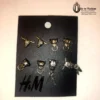
H&M, originally founded in 1947 in Sweden under the name "Hennes," started as a women’s clothing store with a mission to provide affordable yet stylish fashion. The brand quickly gained popularity for its innovative approach to making high-end fashion trends accessible to the average consumer. By the 1960s, H&M had expanded its offerings by acquiring Mauritz Widforss, a men’s clothing store, which allowed the company to diversify into men’s fashion and broaden its customer base. This strategic move marked the beginning of H&M’s transformation into a comprehensive fashion retailer. Over the decades, H&M continued to grow internationally, establishing itself as a global leader in fast fashion. Its reputation for offering trendy, budget-friendly clothing options helped it capture markets worldwide while maintaining a loyal customer base.
One of the most significant factors contributing to H&M’s success has been its groundbreaking collaborations with renowned designers and celebrities. These limited-edition collections have consistently generated excitement and drawn massive crowds to stores. In November 2004, H&M launched its first major designer collaboration with Karl Lagerfeld, the iconic creative director of Chanel. The collection sold out within hours in major cities, setting the stage for future partnerships. Following this success, H&M collaborated with Stella McCartney in 2006, introducing eco-conscious designs that aligned with her sustainable fashion philosophy. That same year, avant-garde Dutch designers Viktor & Rolf brought their bold, artistic vision to the brand, further cementing H&M’s reputation for innovation.
In subsequent years, H&M partnered with a diverse range of designers and cultural icons. Pop star Madonna designed a collection in 2007, blending her signature style with accessible fashion. Later that year, Italian designer Roberto Cavalli created a glamorous line for H&M, appealing to fans of luxury fashion. Collaborations with Japanese label Comme des Garçons (2008), British designer Matthew Williamson (2009), and luxury shoe brand Jimmy Choo (2009) followed, each bringing unique aesthetics to the table. Notably, the Lanvin collaboration in 2010 made high-end Parisian fashion more attainable, with pieces priced significantly lower than the designer’s usual offerings. Isabel Marant’s 2013 collection introduced menswear for the first time in her career, while Alexander Wang’s 2014 line celebrated urban streetwear.
H&M also embraced collaborations with luxury houses like Versace (2011), Marni (2012), and Balmain (2015), ensuring widespread appeal across different demographics. The Balmain x H&M collection, unveiled by designer Olivier Rousteing via Instagram, became one of the most anticipated releases, selling out almost instantly. Similarly, the Kenzo collaboration in 2016 showcased bold prints and vibrant colors inspired by the French-Japanese label’s heritage. Lebanese designer Sandra Mansour made history in 2020 as the first Arab designer to partner with H&M, creating the Fleur du Soleil collection that celebrated femininity and resilience. More recently, Irish designer Simone Rocha’s 2021 collaboration paid homage to her father, John Rocha, blending romanticism with modernity in a highly sought-after line.
Beyond designer collaborations, H&M has leveraged creative campaigns and cultural moments to stay relevant. For instance, during the Coachella Valley Music and Arts Festival in California, H&M announced its partnership with Alexander Wang, tying the collection to the festival’s youthful energy. In 2016, the brand released an annual holiday movie titled
Come Together , directed by acclaimed filmmaker Wes Anderson. Starring Adrien Brody as a train conductor who saves Christmas after a blizzard delays passengers, the short film combined whimsy with heartfelt storytelling. Additionally, popstar Katy Perry headlined H&M’s 2015 Christmas campaign, singing the original soundtrack “Every Day Is A Holiday,” which added a festive touch to the season.
H&M has also championed inclusivity and empowerment through its campaigns. Naomi Campbell returned to collaborate with the brand in 2017 for a global female empowerment commercial, wearing outfits that blurred gender lines. Swedish singer Zara Larsson designed a playful, empowering collection in 2017, reflecting her personal style and message of confidence. Furthermore, H&M has embraced sustainability as a core initiative, launching eco-friendly collections and promoting ethical practices in response to growing consumer demand for responsible fashion.
Today, H&M remains at the forefront of the fashion industry, continually adapting to changing trends and societal values. Its ability to blend affordability, accessibility, and high-fashion inspiration has solidified its status as a household name. Whether through its iconic designer collaborations, culturally relevant campaigns, or commitment to sustainability, H&M continues to evolve, ensuring its place as a dominant force in the ever-changing world of fashion.